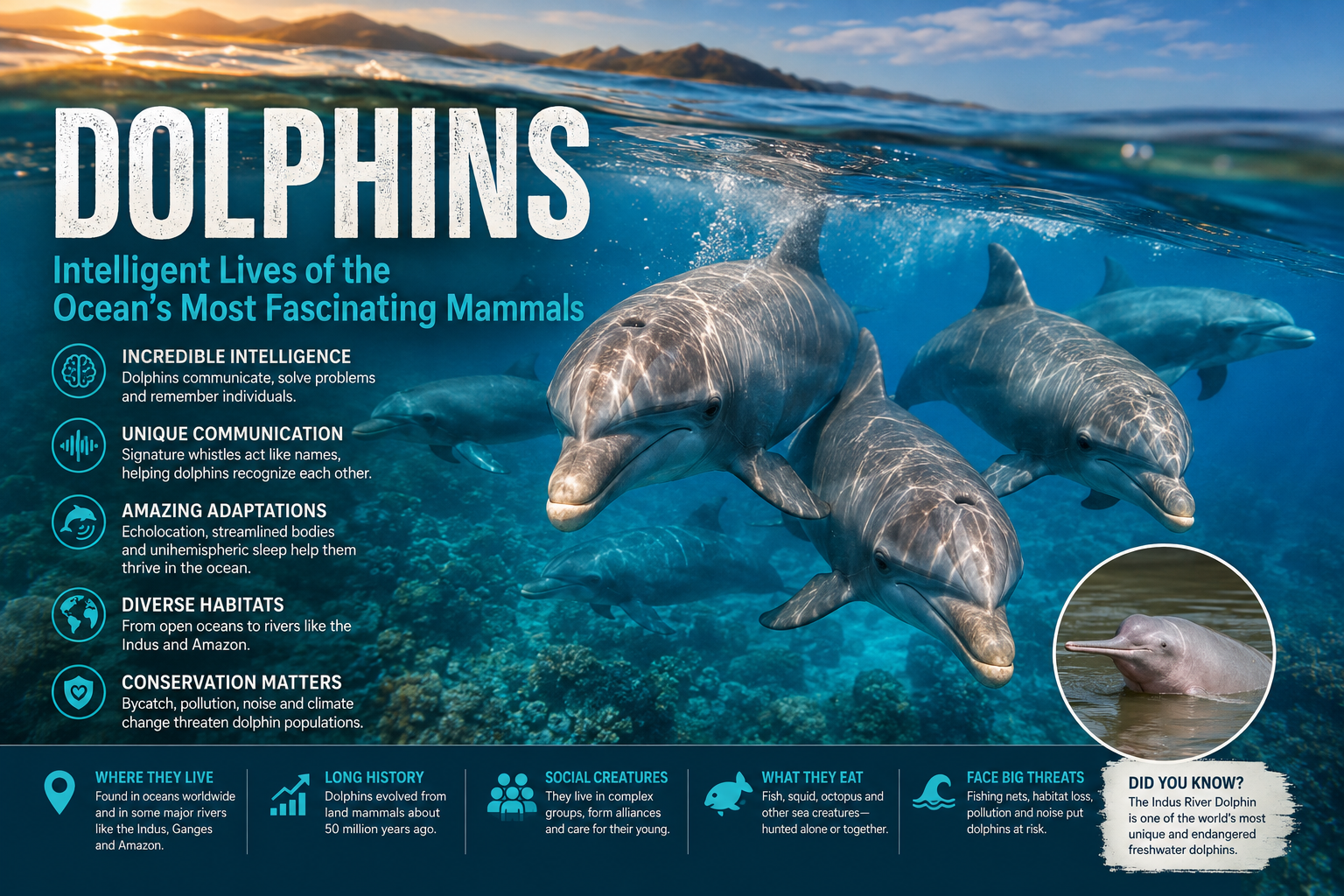
Dolphins are among the most recognizable animals on Earth. We see them jumping beside boats, swimming through clear tropical water and appearing in documentaries as apparently playful and intelligent creatures.
But the familiar image of a dolphin tells only a small part of its story.
Dolphins are not a single species. They are a diverse group of toothed cetaceans that have evolved into remarkably different forms. Some live in warm coastal seas, some spend much of their lives in the open ocean, some travel in enormous groups, while others live in muddy rivers where eyesight is of little use.
Their evolutionary story goes back roughly 50 million years to mammals that lived on land. Their modern social lives can involve cooperation, alliances, individual recognition and complex communication. Some dolphins even have distinctive signature whistles that researchers compare, cautiously, with individual names.
And in 2026, a new study from Shark Bay, Western Australia, added another fascinating possibility: female Indo-Pacific bottlenose dolphins appear able to respond differently to the whistles of individual males with different histories of mating-related behavior. (National Geographic)
So what exactly is a dolphin?
Where did dolphins come from?
How many kinds are there?
Where do they live?
How do they communicate?
Why are some dolphins found in rivers?
And perhaps most importantly, what can dolphins teach us about intelligence and the health of our oceans and rivers?
Let's dive in.
What Is a Dolphin?
A dolphin is an aquatic mammal belonging to the order Cetacea, the group that includes dolphins, porpoises and whales.
Dolphins are also toothed whales, scientifically known as odontocetes. This is important because the word “whale” often makes people imagine enormous baleen whales such as blue whales or humpback whales. But biologically, dolphins are part of the same broader cetacean family tree. (Animal Diversity Web)
Most of the animals commonly called oceanic dolphins belong to the family Delphinidae.
Modern classifications are not completely static. Taxonomists continue to revise relationships between species as genetic and anatomical evidence improves. Animal Diversity Web currently describes Delphinidae as containing about 37 species in 17 genera, illustrating why a simple statement such as “there are exactly X dolphin species” should be treated cautiously. (Animal Diversity Web)
Dolphins are mammals, so they:
breathe air with lungs;
are warm-blooded;
give birth to live young;
nurse their calves with milk;
have complex brains;
must return to the surface to breathe.
Their fish-like appearance is therefore the result of evolutionary adaptation to aquatic life, not evidence that they are fish.
Dolphins Are Related to Whales
The relationship between dolphins and whales is sometimes confusing because common language and scientific classification do not always agree.
In everyday conversation, people often imagine “dolphins” and “whales” as separate categories.
Scientifically, however, dolphins are nested within the toothed-whale branch of Cetacea.
The orca provides the clearest example.
The killer whale, despite its common name, is actually the largest member of the dolphin family, Delphinidae. Members of this family range from relatively small dolphins to orcas approaching 10 metres in length. (Animal Diversity Web)
So when you look at an orca, you are technically looking at the world's largest dolphin.
That is one of the stranger facts in marine biology.
The Evolutionary History of Dolphins
The dolphin story begins on land.
Around 50 million years ago, the ancestors of modern whales and dolphins were terrestrial mammals.
The transition from land to water was not a single event. It was a long evolutionary process involving many different animals and extinct branches.
One of the most famous early cetaceans is Pakicetus, whose fossils have been found in what is now Pakistan and India.
Smithsonian researchers describe early whales such as Pakicetus as four-legged animals that lived around rivers and estuaries in South Asia approximately 50 million years ago. Over subsequent millions of years, descendants became increasingly specialized for aquatic life. (Smithsonian Ocean)
This makes Pakistan especially important in the history of whale and dolphin evolution.
The animal name Pakicetus itself reflects the region where its fossils were discovered.
From Walking Mammals to Ocean Swimmers
Early cetaceans still possessed features associated with land mammals.
They had legs.
Their nostrils were toward the front of the snout.
Their bodies were not shaped like modern dolphins.
Over millions of years, evolutionary changes gradually favored animals better suited to water.
The body became more streamlined.
The hind limbs became reduced.
The forelimbs became flippers.
The tail became the primary source of propulsion.
The nostrils migrated toward the top of the skull.
Eventually, animals that were once capable of moving on land became completely aquatic.
Smithsonian's overview of cetacean evolution describes this transformation as occurring over roughly the past 50 million years. (Smithsonian Ocean)
It is one of the most dramatic transformations in mammalian evolutionary history.
Why Pakistan Matters to Dolphin Evolution
For Pakistani readers, the evolutionary story has a particularly interesting connection.
Some of the oldest and most important early cetacean fossils come from the region that is now Pakistan and surrounding South Asia.
The ancient landscape was obviously very different from modern Pakistan.
Rivers, estuaries and coastal environments provided opportunities for early cetaceans to experiment with aquatic lifestyles.
Scientists have used fossils from the region to reconstruct how these animals gradually changed from land-associated mammals into creatures increasingly dependent on water. (Smithsonian Ocean)
Millions of years later, Pakistan is also home to one of the world's most unusual living dolphins: the Indus River dolphin.
So Pakistan is connected to both the ancient history and the modern conservation story of dolphins.
How Many Dolphin Species Are There?
There is no single number that should be treated as permanently fixed.
Taxonomy changes as scientists discover new information.
The family Delphinidae currently includes dozens of species, while other animals commonly called dolphins—including some river dolphins—belong to different evolutionary lineages. Animal Diversity Web currently lists 37 species within Delphinidae. (Animal Diversity Web)
Some well-known dolphin species and groups include:
Common bottlenose dolphin
Indo-Pacific bottlenose dolphin
Common dolphin
Long-beaked common dolphin
Spinner dolphin
Atlantic spotted dolphin
Pantropical spotted dolphin
Striped dolphin
Clymene dolphin
Risso's dolphin
Dusky dolphin
Hector's dolphin
Irrawaddy dolphin
Atlantic humpback dolphin
Amazon river dolphin
Ganges River dolphin
Indus River dolphin
And the orca belongs to the dolphin family as well.
This diversity matters because there is no single “dolphin lifestyle.”
A bottlenose dolphin living near a coastline and an Indus River dolphin living in muddy freshwater face completely different environmental challenges.
Major Dolphin Habitats Around the World
Dolphins inhabit an enormous range of aquatic environments.
They can be found in:
tropical oceans;
subtropical waters;
temperate seas;
coastal zones;
bays;
estuaries;
continental shelves;
offshore waters;
deep ocean environments;
large rivers;
freshwater systems;
brackish waters.
Common bottlenose dolphins, for example, are found in both coastal and offshore waters and can inhabit bays, gulfs, harbors, estuaries and open-ocean environments. (NOAA Fisheries)
Other species have much narrower ranges.
The Atlantic humpback dolphin, for instance, has a fragmented distribution along the western coast of Africa, and NOAA describes its populations as small, with some numbering only in the tens to low hundreds. (NOAA Fisheries)
Where in the World Do Dolphins Live?
Dolphins occur across the major oceans.
Atlantic Ocean
The Atlantic supports common dolphins, bottlenose dolphins, spotted dolphins, humpback dolphins and several other species.
Pacific Ocean
The Pacific is home to spinner dolphins, spotted dolphins, bottlenose dolphins, common dolphins and many other cetaceans.
Indian Ocean
Dolphins occur throughout tropical and subtropical Indian Ocean waters, including around South Asia, East Africa and island regions.
Mediterranean Sea
Several cetacean species occur in the Mediterranean, including dolphins and larger toothed whales. IUCN assessments have highlighted conservation concerns for several Mediterranean cetacean populations. (IUCN)
Australian waters
Australia is particularly important for dolphin research. Shark Bay in Western Australia has become one of the world's best-known long-term dolphin research sites.
South Asian rivers
South Asia contains some of the world's most distinctive freshwater dolphins, including the Ganges and Indus river dolphins.
Ocean Dolphins and River Dolphins Are Not the Same
One of the biggest mistakes people make is treating every dolphin as a marine animal.
Some dolphins have adapted to freshwater.
Their bodies and senses can look very different from familiar oceanic dolphins.
The South Asian river dolphin, for example, has extraordinarily poor eyesight and relies heavily on echolocation to navigate and locate prey. (IUCN Red List)
That makes sense in its environment.
The waters of the Indus and other South Asian rivers can be extremely turbid.
There may be little useful visual information.
Sound becomes far more valuable.
Evolution has effectively shifted the dolphin's sensory priorities toward an acoustic world.
The Indus River Dolphin: Pakistan's Unique Dolphin
The Indus River dolphin, locally known as the bhulan, is one of the world's most distinctive freshwater cetaceans.
Its scientific name is Platanista gangetica minor.
NOAA describes it as one of the world's most endangered cetaceans and notes that its eyes are so reduced that scientists consider it functionally blind, with vision limited mainly to detecting light levels and direction. (NOAA Fisheries)
Its main sensory tool is therefore echolocation.
The dolphin produces sounds and interprets returning echoes to understand its surroundings.
This is an extraordinary adaptation.
The animal does not need clear water.
It has evolved to live in water where seeing clearly is almost impossible.
The Indus Dolphin's Range Has Shrunk
The Indus River dolphin once occupied a much larger portion of the Indus system.
The construction of irrigation barrages and other changes to river flow fragmented its habitat.
WWF reports that its historical range has been reduced by around 80 percent, with the remaining population concentrated mainly in the lower parts of the Indus River in Pakistan. (WWF Panda)
The same source identifies dams, fishing-net entanglement and pollution among the major threats.
This is a reminder that protecting a river dolphin requires more than protecting individual animals.
The river itself must remain healthy.
The Ganges River Dolphin
The Ganges River dolphin, commonly known as the susu, is closely related to the Indus River dolphin.
Historically, South Asian river dolphins occupied interconnected river systems across the region.
IUCN material describes the South Asian river dolphin as an endangered species associated with the Indus, Ganges, Meghna-Brahmaputra and Karnaphuli river systems. (IUCN Red List)
The major threats include:
river fragmentation;
dams and barrages;
reduced water flow;
fishing gear;
pollution;
boat traffic;
habitat degradation.
The story of the South Asian river dolphins is therefore closely connected with the story of South Asia's rivers.
The Amazon's Famous Pink Dolphin
Travel thousands of kilometres away from the Indus and the dolphin story changes again.
The Amazon river dolphin, commonly called the pink river dolphin or boto, lives in South America's freshwater systems.
Some adults develop a striking pink coloration, although individuals vary considerably.
Unlike marine dolphins that usually move through open water, Amazon river dolphins can navigate complicated freshwater environments and flooded forests.
Their habitat can change dramatically with seasonal water levels.
But they face serious threats.
Pollution, fishing pressure, habitat degradation and mercury contamination associated with gold mining have all raised concerns about their future.
The Amazon dolphin demonstrates something important about dolphin evolution:
there is no single environment that defines what a dolphin must be.
Dolphins Have Streamlined Bodies for a Reason
Look closely at a dolphin.
Almost every part of its body contributes to efficient movement through water.
The body is streamlined.
The tail provides propulsion.
The flippers help control movement.
The dorsal fin contributes to stability.
The blowhole allows rapid access to air.
The skin and body shape reduce resistance.
This is evolutionary engineering at work.
A dolphin does not swim through water by moving its entire body like a fish.
Its powerful tail flukes move primarily up and down, generating thrust.
How Dolphins Breathe
Dolphins breathe through a blowhole located on top of the head.
This is one of the clearest signs that dolphins are mammals.
When the dolphin surfaces, it can quickly exhale and inhale before returning underwater.
The blowhole's location means the dolphin does not have to raise its entire head above the surface.
This is especially efficient for an animal that may spend much of its life underwater.
How Dolphins Sleep Without Drowning
Sleep creates a unique problem for dolphins.
Humans can sleep while breathing automatically.
Dolphins must consciously manage surfacing and breathing while living underwater.
Their solution involves a form of unihemispheric sleep, in which one hemisphere of the brain can remain relatively active while the other rests.
This allows dolphins to maintain essential behaviors while obtaining rest.
It is another example of how the dolphin body is adapted around a fundamental problem:
How does a breathing mammal sleep in an environment where there is no air?
Echolocation: The Dolphin's Underwater Sonar
Perhaps no dolphin ability is more famous than echolocation.
The process is surprisingly sophisticated.
A dolphin produces rapid clicks.
Those sounds travel through the water.
When they hit an object, some sound energy returns.
The dolphin receives the returning echoes and can use them to detect objects and prey.
This gives dolphins a form of biological sonar.
NOAA describes echolocation as an important part of how dolphins locate prey, while Smithsonian research documents the extensive use of clicks and whistles in dolphin acoustic behavior. (NOAA Fisheries)
For an Indus River dolphin living in muddy water, this ability can be particularly important.
Dolphins Do Not Only Make Clicks
Dolphin communication is much more complicated than echolocation.
Researchers have recorded:
whistles;
clicks;
pulsed sounds;
squeaks;
calls;
pops;
screams;
other social vocalizations.
Smithsonian research describes bottlenose dolphins as producing echolocation clicks as well as social sounds including whistles, calls, screams, barks, pops and quacks. (Smithsonian Tropical Research Institute)
The distinction matters.
A click used for echolocation is not necessarily performing the same function as a social whistle.
The dolphin's acoustic world contains different kinds of information.
Do Dolphins Have Names?
This is one of the most fascinating areas of dolphin research.
Bottlenose dolphins develop distinctive signature whistles.
These whistles can identify individual dolphins.
Research in Shark Bay has shown that dolphins can recognize and respond to signature whistles associated with particular individuals. Previous research also found that male bottlenose dolphins use individual identity signals within their complex social alliances. (National Geographic)
Calling these whistles “names” is a useful comparison, but it should not be taken literally.
Scientists have not demonstrated that dolphin communication is equivalent to human language.
What the research does show is that individual identity can be encoded acoustically.
That is remarkable in itself.
The 2026 Discovery: Female Dolphins May Remember Which Males to Avoid
This is where the story becomes particularly interesting.
In 2026, researchers studying Indo-Pacific bottlenose dolphins in Shark Bay investigated how females responded to the signature whistles of individual males.
The study examined whether females responded differently depending on a male's history of consortship behavior.
In dolphin society, male alliances can cooperate to control access to females during mating-related consortships. These interactions can sometimes involve chasing, biting, hitting or other aggressive behavior toward females. (National Geographic)
Researchers played recordings of male signature whistles and monitored female responses.
The result was striking.
Females that were reproductively available were more likely to move away from the whistles of males with a history of consorting females.
Females that were older or caring for calves, and therefore less likely to be targeted for mating, showed weaker avoidance responses. (Smithsonian Magazine)
The researchers suggest that females may be keeping track of individual males and associating their identity signals with previous social information.
But there is an important scientific caution.
We cannot yet say exactly how the females acquired that information.
They may have personal memories.
They may learn from observing other dolphins.
They may acquire information socially.
Or several mechanisms may operate simultaneously.
The finding is therefore best described as evidence of sophisticated social recognition and decision-making—not proof that dolphins think exactly like humans.
Dolphin Society Is More Complicated Than a “Pod”
The word “pod” can make dolphin society sound simple.
It isn't.
Dolphin groups can change over time.
Individuals may join or leave.
Relationships can be temporary or long-lasting.
Some males form alliances.
Some females spend substantial time with other females and their offspring.
Young dolphins learn from adults.
Researchers studying Shark Bay have documented particularly complicated male alliances, including relationships in which pairs or groups of males cooperate and larger alliances can cooperate with one another. (Nature)
This means dolphins live in a social world where remembering individuals can have real survival and reproductive value.
Male Dolphin Alliances
Male bottlenose dolphins in Shark Bay are famous for cooperation.
Two or three males can form alliances, and those alliances may interact with other alliances.
Scientists describe these relationships as a nested social structure.
The males may cooperate to herd females, defend relationships and compete with rival males. (Nature)
This is not simply brute force.
It requires coordination.
The dolphins must recognize partners.
They must respond to one another.
They must maintain relationships.
And they must make decisions in rapidly changing circumstances.
This is one reason dolphin social intelligence has attracted so much scientific attention.
Dolphins Learn From Each Other
A dolphin calf does not enter the world with a complete instruction manual.
It has to learn.
It watches its mother.
It interacts with other dolphins.
It practices hunting.
It develops sounds.
It learns social rules.
It becomes familiar with individuals.
This process means dolphin populations can have something resembling a social culture.
Certain feeding techniques and behaviors can become associated with particular populations.
The environment matters, but so does what dolphins learn from one another.
What Do Dolphins Eat?
Dolphins are predators, although their exact diet depends on species and habitat.
Common prey includes:
fish;
squid;
octopus;
shrimp;
crabs;
other aquatic animals.
Bottlenose dolphins are particularly flexible hunters.
NOAA reports that they can hunt alone or cooperate with other dolphins to herd fish. Some individuals may even trap fish against sandbars or seawalls. (NOAA Fisheries)
This flexibility is one reason bottlenose dolphins have successfully adapted to different environments.
Dolphins Usually Swallow Fish Whole
Dolphin teeth are designed primarily to catch and grip prey.
They are not grinding teeth like human molars.
A bottlenose dolphin typically catches a fish, grips it with its teeth and swallows it whole.
NOAA notes that dolphins commonly swallow fish head first, which can reduce the risk of the fish's spines becoming lodged in the throat. (NOAA Fisheries)
It is a small detail, but it shows how closely anatomy and behavior fit together.
Dolphins Can Hunt Cooperatively
Imagine a school of fish moving through the water.
A single dolphin can chase them.
But several dolphins working together can create a very different hunting strategy.
Some dolphins may herd fish.
Others may position themselves around the school.
Then individuals can take turns moving through the concentrated prey.
NOAA has documented this type of cooperative feeding behavior in bottlenose dolphins. (NOAA Fisheries)
Cooperation therefore isn't merely a social activity.
It can directly affect access to food.
Dolphin Calves: Learning From the Beginning
A dolphin calf has a lot to learn.
Swimming is essential.
Breathing is essential.
Finding food is essential.
Social recognition is essential.
The relationship between mother and calf therefore plays a major role in early life.
NOAA describes the characteristic “baby position” in bottlenose dolphins, where a calf swims close behind and slightly to the side of its mother. This positioning allows nursing access and may reduce the calf's swimming effort by taking advantage of the mother's slipstream. (NOAA Fisheries)
For the calf, the mother is not just a source of milk.
She is also its first teacher.
How Long Do Dolphins Live?
Lifespan varies considerably by species.
Some dolphins live for decades.
Bottlenose dolphins are particularly long-lived compared with many other small cetaceans, with some individuals reaching several decades.
This long lifespan matters because intelligence and social learning become more valuable when an animal has many years in which to build relationships and accumulate experience.
An older dolphin may have something a younger dolphin does not:
a long memory of the social world.
Are Dolphins Friendly?
This is a difficult question because “friendly” is a human concept.
Dolphins can be social.
They can be playful.
They can show affiliative behavior such as rubbing against one another.
But they can also compete and behave aggressively.
NOAA's description of bottlenose dolphin behavior includes breeding, playing, aggression and gentle body contact. (NOAA Fisheries)
The recent Shark Bay research also reminds us that dolphin society contains conflicts and coercive mating behavior.
So dolphins are not simply “friendly animals.”
They are complex wild animals.
That distinction matters.
Dolphins and Humans
Humans have had a long fascination with dolphins.
Ancient sailors encountered them.
Stories and myths developed around them.
Modern people have turned them into symbols of intelligence, friendliness and freedom.
Dolphin watching has become an important tourism industry in many coastal areas.
But the relationship is not always beneficial to dolphins.
Boats can disturb them.
Fishing gear can trap them.
Pollution can accumulate in their bodies.
Noise can interfere with communication.
Habitat changes can reduce access to food.
Our relationship with dolphins therefore has two sides.
We admire them, but our activities can also threaten them.
Fishing Nets Are a Major Threat
One of the most serious threats facing many dolphins is bycatch.
Bycatch occurs when dolphins are unintentionally caught in fishing equipment.
Gillnets and other fishing gear can entangle dolphins, preventing them from reaching the surface.
NOAA has identified fisheries bycatch as a major global threat to cetaceans. (NOAA Fisheries)
For river dolphins, fishing nets can be especially dangerous because the animals already live in relatively restricted river channels.
Conservation therefore often requires changes in fishing practices rather than simply protecting dolphins after they are caught.
Noise Pollution Can Affect Dolphins
The ocean is becoming increasingly noisy.
Commercial ships.
Speedboats.
Construction.
Industrial activity.
Tourist vessels.
These sounds can interfere with animals that depend heavily on hearing.
Research in Panama found that dolphin-watching activity and boat traffic can affect the frequency characteristics of bottlenose dolphin whistles. (Smithsonian Tropical Research Institute)
That is important because communication is not an optional feature of dolphin life.
Their social world depends on sound.
If human noise makes communication more difficult, the consequences could extend beyond temporary annoyance.
Pollution Enters the Food Chain
Dolphins are relatively high in aquatic food webs.
That means pollutants can reach them through their prey.
A chemical may enter water.
Small organisms absorb it.
Fish eat those organisms.
Larger fish eat smaller fish.
Dolphins then eat the fish.
This process can expose dolphins to contaminants accumulated through the food chain.
River dolphins can be particularly vulnerable because rivers receive pollution from agriculture, industry, mining, sewage and urban development.
Climate Change and Dolphins
Climate change does not necessarily need to kill a dolphin directly to affect it.
Changing ocean temperatures can alter prey distributions.
If fish move, dolphins may have to move.
If important feeding grounds become less productive, reproductive success may be affected.
NOAA describes dolphins and porpoises as useful indicators of broader environmental conditions and identifies climate change, pollution, habitat degradation and noise among human pressures affecting cetaceans. (NOAA Fisheries)
This makes dolphins valuable not only as animals worth protecting but also as indicators of ecosystem health.
Why Dolphins Are Important to the Ecosystem
Dolphins are predators near the upper levels of aquatic food webs.
They influence prey populations.
They compete with other predators.
They themselves can become prey for larger predators.
Their health can reveal changes in the wider ecosystem.
NOAA describes dolphins and porpoises as important components of marine ecosystems and as potential sentinels of ocean health. (NOAA Fisheries)
So protecting dolphins is not simply an emotional conservation goal.
Healthy dolphin populations can be part of healthy aquatic ecosystems.
Some Dolphins Are Critically Threatened
It is important not to make the mistake of assuming that all dolphins are equally safe.
Their conservation status varies dramatically.
The Atlantic humpback dolphin, for example, is considered endangered and has very small, fragmented populations. NOAA identifies fisheries bycatch, prey depletion, coastal development, deliberate capture and anthropogenic noise among its threats. (NOAA Fisheries)
The Indus River dolphin faces a different combination of threats.
The Yangtze river dolphin, or baiji, provides perhaps the most painful warning.
IUCN material describes the baiji as having been declared likely extinct in 2006 after threats including habitat loss, fishing-gear entanglement and ship strikes were not adequately controlled. (IUCN Portals)
The lesson is straightforward:
A species can disappear when environmental pressure continues for too long.
Why River Dolphin Conservation Is So Difficult
Protecting an ocean dolphin is already challenging.
Protecting a river dolphin can be even more complicated.
A river is not an isolated habitat.
Water moves.
Dams change flows.
Agriculture consumes water.
Cities discharge wastewater.
Fishing occurs throughout the system.
Industrial pollution can travel downstream.
A dolphin population may therefore depend on decisions made hundreds of kilometres away.
For the Indus dolphin, conservation is inseparable from water management.
What Can Be Done to Protect Dolphins?
Dolphin conservation requires different solutions in different regions.
Some important measures include:
Reducing fishing bycatch
Modify nets and fishing practices so dolphins can escape or avoid dangerous gear.
Protecting critical habitat
Identify areas used for feeding, breeding and resting.
Managing boat traffic
Keep vessels at safe distances and reduce repeated pursuit of dolphins.
Reducing underwater noise
Limit unnecessary noise in important habitats.
Improving water quality
Reduce industrial, agricultural and urban pollution.
Maintaining river flows
Ensure freshwater dolphins have enough suitable habitat.
Protecting prey populations
Healthy dolphin populations require healthy food webs.
Supporting local communities
Conservation works better when fishermen and river communities are part of the solution.
Responsible Dolphin Tourism
Dolphin tourism can create strong economic incentives to protect wildlife.
But poorly managed tourism can have the opposite effect.
NOAA recommends responsible wildlife viewing and identifies vessel disturbance, harassment and illegal feeding as issues that can affect dolphins. (NOAA Fisheries)
A responsible dolphin-watching operator should prioritize:
keeping a respectful distance;
avoiding sudden approaches;
avoiding repeated chasing;
allowing dolphins to control the interaction;
reducing noise;
never feeding wild dolphins;
following local wildlife regulations.
The goal should be observation, not entertainment at any cost.
Dolphins Are Not the “Perfect” Animal
Popular culture often presents dolphins as almost magical.
They are intelligent.
They smile.
They leap.
They appear to enjoy interacting with humans.
But nature is more complicated.
Dolphins compete.
They hunt.
They form alliances.
They can be aggressive.
They have predators.
They can be injured.
They can become sick.
They can be affected by environmental contamination.
The more we learn about dolphins, the more useful it becomes to see them not as idealized creatures but as complex animals with their own evolutionary history and social lives.
What Makes Dolphin Intelligence Special?
Calling dolphins “intelligent” is easy.
Understanding what their intelligence actually means is harder.
Their intelligence appears particularly suited to social life.
They need to recognize individuals.
They need to cooperate.
They need to remember relationships.
They need to learn hunting strategies.
They need to communicate.
They need to navigate complex environments.
In other words, dolphin intelligence is not simply about solving laboratory puzzles.
It is about surviving in a complicated underwater world.
Dolphins and the Question of Consciousness
Scientists have studied dolphin cognition for decades.
Some research has examined mirror self-recognition and other advanced cognitive abilities.
But we should avoid going too far.
It is reasonable to say dolphins show sophisticated cognition.
It is much harder to answer questions such as:
What does the world feel like to a dolphin?
We cannot directly experience another animal's consciousness.
What science can do is study behavior, learning, memory, communication and neurological systems.
The evidence suggests dolphins are cognitively sophisticated.
The precise nature of their subjective experience remains unknown.
Why the Latest Research Matters
The 2026 Shark Bay study is important because it shifts attention from a simple question—“Are dolphins intelligent?”—to a much more interesting one:
How do dolphins use information about other individuals when making social decisions?
Researchers found that reproductively available females were more likely to avoid the signature whistles of males associated with previous consortship behavior. Females that were less likely to be targeted did not show the same strength of response. (Smithsonian Magazine)
That suggests that dolphin social information may be more sophisticated than previously appreciated.
But the responsible scientific interpretation is cautious.
The research does not show that dolphins possess human-style gossip, morality or language.
Instead, it provides evidence that individual identity signals can be associated with socially relevant information.
That is fascinating enough without exaggerating it.
Dolphins May Have a Memory for People—or Rather, Dolphins
Imagine living in a society where hundreds of individuals may pass through your environment over many years.
Remembering who is who would be valuable.
A signature whistle provides an acoustic identity signal.
A dolphin can associate sounds with individuals.
That means the underwater world may contain something humans cannot easily perceive:
a constantly moving network of recognizable voices.
Every whistle may identify an individual.
Every individual may have a history.
And every relationship may change over time.
That is an incredibly complex social environment.
The Dolphin World Is a World of Sound
Humans experience the world largely through vision.
Dolphins experience theirs very differently.
Sound travels efficiently through water.
Echolocation reveals objects.
Whistles maintain social contact.
Calls communicate during interactions.
Individual signature whistles identify dolphins.
This means that if humans could somehow experience the world as a dolphin does, the ocean might feel completely different.
Instead of relying primarily on sight, we would constantly interpret an acoustic landscape.
For an Indus River dolphin living in muddy water, this difference is even more extreme.
What We Still Don't Know
Despite decades of research, major questions remain.
Scientists are still investigating:
how dolphins understand individual signature whistles;
how much information their vocalizations contain;
how dolphin cultures develop;
how social learning spreads;
how long individual memories last;
how dolphins understand relationships;
how environmental noise affects communication;
how climate change will reshape dolphin populations;
how different dolphin species evolved their distinctive lifestyles.
This is perhaps the most exciting thing about dolphin research.
The story isn't finished.
Fascinating Dolphin Facts
1. Dolphins are mammals
They breathe air, give birth to live young and nurse their calves.
2. The orca is a dolphin
The killer whale is the largest member of the dolphin family. (Animal Diversity Web)
3. Dolphins evolved from land mammals
Their evolutionary history stretches back roughly 50 million years. (Smithsonian Ocean)
4. Some dolphin ancestors lived in South Asia
Early cetacean fossils such as Pakicetus are associated with what is now Pakistan and India. (Smithsonian Ocean)
5. Some dolphins live in rivers
The Indus and Ganges river dolphins are famous examples.
6. Indus dolphins have extremely poor eyesight
They rely heavily on echolocation. (NOAA Fisheries)
7. Dolphins use signature whistles
These can identify individual dolphins. (National Geographic)
8. Dolphins can hunt cooperatively
Bottlenose dolphins can work together to herd fish. (NOAA Fisheries)
9. Dolphins can be aggressive
Social life includes cooperation, competition and aggression.
10. Fishing gear is a major threat
Bycatch is one of the most important human-related threats to many cetaceans. (NOAA Fisheries)
11. Noise can change dolphin communication
Boat traffic has been shown to influence dolphin whistle characteristics. (Smithsonian Tropical Research Institute)
12. Some dolphin species are seriously endangered
Conservation status varies greatly between species. (NOAA Fisheries)
Frequently Asked Questions About Dolphins
Are dolphins fish?
No. Dolphins are mammals and breathe air through lungs.
Are dolphins whales?
Dolphins are cetaceans and belong to the toothed-whale branch of Cetacea. The orca is technically the largest member of the dolphin family. (Animal Diversity Web)
How do dolphins breathe?
They breathe through a blowhole on the top of their head.
Can dolphins breathe underwater?
No. They hold their breath while underwater and must surface to breathe.
How do dolphins communicate?
They use whistles, clicks, calls and other sounds, along with physical and visual behaviors. (Smithsonian Tropical Research Institute)
Do dolphins have names?
Many bottlenose dolphins develop distinctive signature whistles that identify individuals. Scientists sometimes compare these whistles to names, although dolphin communication has not been shown to be equivalent to human language.
How do dolphins find prey?
Many toothed dolphins use echolocation, which allows them to detect objects and prey using returning sound waves. (NOAA Fisheries)
What do dolphins eat?
Depending on the species, dolphins eat fish, squid, octopus, crustaceans and other aquatic prey.
Do dolphins live in freshwater?
Yes. Several species are adapted to freshwater or river environments, including the Indus, Ganges and Amazon river dolphins.
Where is the Indus River dolphin found?
It occurs in the Indus River system in Pakistan and is one of the world's most endangered cetaceans. (NOAA Fisheries)
Why is the Indus River dolphin endangered?
Major threats include habitat degradation, changes in river flow, fishing-net entanglement and chemical pollution. (NOAA Fisheries)
Are dolphins intelligent?
Yes. Research demonstrates sophisticated learning, memory, communication and social behavior. However, scientists should not automatically equate dolphin cognition with human intelligence.
Do dolphins sleep?
Yes. Dolphins use specialized sleep patterns that allow them to rest while continuing to surface and breathe.
How long do dolphins live?
Lifespan varies by species. Some bottlenose dolphins can live for several decades.
Are dolphins friendly to humans?
Some dolphins appear curious around humans, but they are wild animals. They should not be treated as domesticated or harmless pets.
Dolphins: A Story That Is Still Being Written
Dolphins have been swimming through Earth's waters for millions of years.
Their ancestors began as land mammals.
Their descendants became completely aquatic.
They developed streamlined bodies, powerful tails and sophisticated acoustic systems.
Some moved into the open ocean.
Some stayed near coasts.
Some adapted to rivers.
One lineage survived in the Indus River and became deeply connected with Pakistan's natural heritage.
Others became highly social ocean predators.
And some, such as the orca, became apex predators capable of sophisticated cooperative hunting.
Today, scientists are still uncovering new layers of dolphin behavior.
The latest research from Shark Bay is a good example.
A dolphin whistle that sounds like a simple underwater sound to a human observer may actually identify a particular individual. A female may hear that whistle and respond differently based on what she has learned about that male's behavior. (National Geographic)
That does not mean dolphins are underwater humans.
It means something more interesting.
They are intelligent animals with their own way of understanding the world.
Their intelligence evolved independently of ours.
Their communication evolved underwater.
Their social rules developed in a three-dimensional environment.
Their senses are dominated by sound.
Their survival depends on relationships, memory, cooperation and adaptation.
And the more we study them, the more we realize how little we truly know.
Perhaps that is the most fascinating thing about dolphins.
We have spent decades asking whether they are intelligent.
The better question now may be:
What kind of intelligence have dolphins developed that humans have only just begun to understand?
Sources and References
The article above has been researched using multiple sources for major topics, rather than relying on a single article. Where possible, primary scientific, government, museum and conservation sources were prioritized.
1. National Geographic — 2026 Dolphin Social Behavior Research
The recent Shark Bay research concerning female dolphins responding to male signature whistles and male consortship history.
National Geographic — How female dolphins know which males to avoid (National Geographic)
2. Smithsonian Institution — Whale and Dolphin Evolution
Used particularly for the evolutionary history of cetaceans, including early whales such as Pakicetus and the transition from land to water.
Smithsonian Ocean — Whales and Dolphins (Smithsonian Ocean)
3. NOAA Fisheries — Common Bottlenose Dolphin
Used for information about habitat, diet, hunting, social behavior, calves and echolocation.
NOAA Fisheries — Common Bottlenose Dolphin: Science (NOAA Fisheries)
4. NOAA Fisheries — Dolphins and Porpoises
Used for information about cetaceans, ecosystem roles, communication, echolocation, environmental pressures and ocean health.
NOAA Fisheries — Dolphins & Porpoises (NOAA Fisheries)
5. NOAA Fisheries — Indus River Dolphin
Used for information about the Indus River dolphin, its biology, distribution, size, eyesight and conservation threats.
NOAA Fisheries — Indus River Dolphin (NOAA Fisheries)
6. IUCN — South Asian River Dolphin
Used for historical range, endangered status, echolocation, river development and major conservation threats.
IUCN — South Asian River Dolphin (IUCN Red List)
7. WWF — Freshwater Biodiversity / Indus River Dolphin
Used for information about the reduction of Indus dolphin range and threats from river development, fishing nets and pollution.
WWF — Freshwater Biodiversity (WWF Panda)
8. Smithsonian Tropical Research Institute — Dolphin Communication
Used for dolphin whistles, echolocation, social sounds and the effects of boat traffic on dolphin communication.
Smithsonian Tropical Research Institute — Can't Hear You! (Smithsonian Tropical Research Institute)
9. Animal Diversity Web — Delphinidae
Used as a cross-check for taxonomy, physical characteristics, geographic distribution, behavior and diversity within the dolphin family.
Animal Diversity Web — Delphinidae (Animal Diversity Web)
10. IUCN — Cetacean Conservation
Used for broader information concerning threatened cetaceans, river dolphins and conservation challenges.
IUCN Library — Cetaceans (IUCN Portals)
11. NOAA Fisheries — Global Cetacean Bycatch
Used for the discussion of fishing bycatch as a major threat to dolphins and other cetaceans.
NOAA Fisheries — Worldwide Bycatch of Cetaceans (NOAA Fisheries)
12. Smithsonian Institution — Ancient River Dolphins
Used to cross-check information concerning fossil river dolphins and the evolutionary history of freshwater cetaceans.
Smithsonian — New Species of Extinct River Dolphin Discovered (Smithsonian Institution)