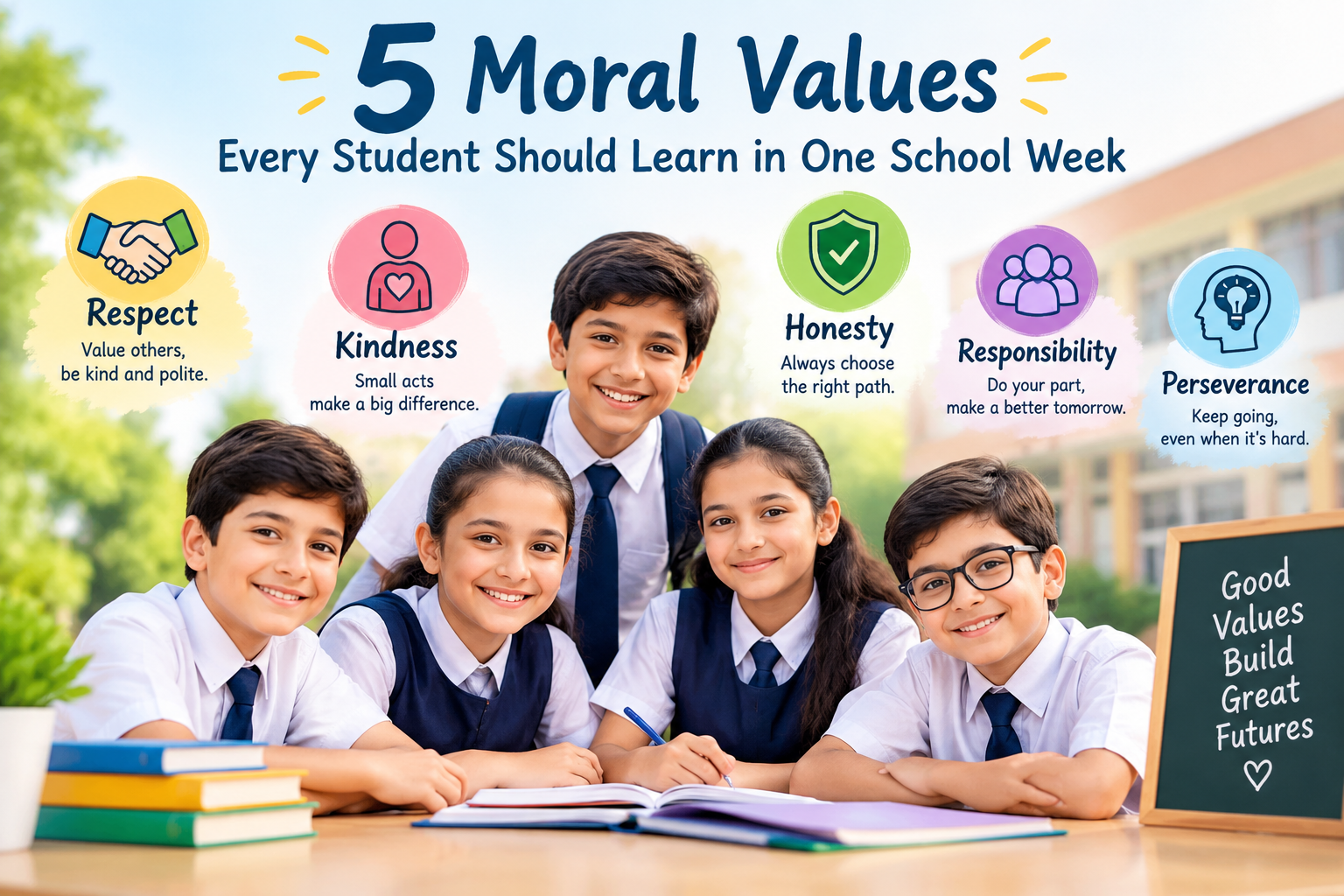
In today’s fast paced world, helping children to develop a strong moral compass is as important as academic skills. Research shows that educating for values not only promotes personal integrity but also builds resilience and cooperative social behavior. In one intensive school week, teachers and parents can focus on five key values with lasting impact. These values are Honesty, Compassion, Respect, Responsibility and Fairness. Each is backed by child development research or global education guidance. We present practical classroom lessons, real life examples and home reinforcement tips for each value. Below we explain why each value was chosen and how to bring it alive for students of ages between 8 to14.
1. Honesty
Why it matters: Honesty is telling the truth and acting sincerely, even when it’s hard. It is “an aspect of integrity” that keeps trust in a classroom. Educational experts note that honesty must be explicitly taught and modeled, students learn that not lying and following rules (“playing by the rules”) helps them do the right thing. Consistent honesty builds a positive learning environment and personal responsibility for one’s actions.
Key messages: We teach that honesty means “saying what we mean and meaning what we say”. Teachers can link honesty to integrity by explaining: “When our words align with our actions, we are behaving ethically”. Anecdotes, stories and role plays help make the concept concrete.
Quotes: “Honesty is the first chapter in the book of wisdom.” — Thomas Jefferson.
“No legacy is so rich as honesty.” — William Shakespeare.
Original Anecdote: One day, Maria accidentally knocks over a paint jar in art class and makes a big mess. Even though she worries about being scolded, Maria raises her hand and tells the teacher the truth. As they clean up together, the teacher praises Maria’s honesty. Maria learns that admitting a mistake earns respect and helps solve problems quickly.
Classroom Example: Read a short story like The Empty Pot (a classic picture book) showing a child rewarded for honesty. Then discuss: “What would you have done?”, “Why is it better to tell the truth even if it might get you in trouble?”
Home Tip: Parents can reinforce honesty by praising kids when they admit mistakes or confess truthfully (e.g. “Thank you for telling me what happened”). Model honesty by talking about times you faced a tough truth yourself. To discuss right reasons, use natural moments: “We returned the extra change to the shop because honesty is important to our family.”
2. Compassion (Empathy)
Why it matters: Compassion means understanding and caring about others’ feelings. Developmental research shows that empathy allows children to cooperate, make friends, and intervene to help peers in need. One psychology summary notes: “Empathy helps us cooperate with others, build friendships, make moral decisions and intervene when we see others being bullied.”. In short, empathy drives kind acts that we want to see in the world.
Quotes: “No act of kindness, no matter how small, is ever wasted.” — Aesop.
“Be kind, for everyone you meet is fighting a hard battle.” — Plato (often cited).
Original Anecdote: At recess, Jamal sees his classmate Priya sitting alone looking upset. He remembers how he feels when he’s lonely, so he sits with her and asks if everything is okay. Priya smiles and starts telling him why she’s sad. Jamal just listens. By lunchtime, they are chatting and playing together. Priya thanks Jamal: “I feel so much better that you understand.” Jamal learns that a little compassion can turn someone’s day around.
Classroom Example: Use an “empathy mapping” activity: read a story where a character feels hurt or left out (e.g. A Sick Day for Amos McGee or a bullying scenario). Ask: “What do you think X feels right now? What would you do?” For younger kids, role play feelings with puppets or drawings (happy vs sad faces). For older kids, encourage them to share a time someone helped them feel better when they were sad or scared. Discussion prompt: “Have you ever helped someone feel better? How did that make you feel?”
Home Tip: Parents can cultivate empathy by discussing emotions openly (“How do you think your friend felt when that happened?”). Encourage children to practice “putting themselves in others’ shoes” daily. Praise kindness when you see it, and consider family service (e.g. helping at a community garden) to practice caring beyond the home.
3. Respect
Why it matters: Respect is a fundamental value tied to human dignity and cooperation. UNICEF education guidance emphasizes values that promote “respect, equity and social responsibility.” Respect includes listening and valuing everyone’s ideas. In practical terms, respectful students treat peers, teachers and the environment kindly. Research underscores that teaching respect for diversity and rules builds a positive classroom culture and mutual trust. In fact, one education leader stresses that embedding respect (“the value of ‘respect’ also means to listen”) is urgent in today’s connected world.
Quotes: “Respect yourself and others will respect you.” — Confucius.
“We must learn to live together as brothers or perish together as fools.” — Martin Luther King Jr.
Original Anecdote: During a class discussion, Ahmed and Sara disagree about a project idea. Sara notices Ahmed’s frustrated face and realizes he feels strongly. Instead of interrupting, she listens quietly while he explains his plan. Later, Ahmed thanks Sara for listening. The teacher points out their respectful interaction: even with different views, they listened and respected each other. Both students see that respect leads to better teamwork.
Classroom Example: Hold a “Respect Charter” activity. Begin with a discussion: “What does respect look like in our classroom? How do we show respect for people or for materials?” Brainstorm key respect behaviors (listening when others speak, using polite words, raising hands, looking at speakers). Then have students help create a colorful poster “Classroom Respect Rules.” Encourage them to role-play scenarios: e.g. one student interrupts another, and peers show why pausing to listen is respectful. Adaptation: For younger children (8–10), use clear rules and picture cues (listen/raise hand). Older students can reflect on respect beyond class (respecting nature, other cultures) and discuss a current event in respectful terms.
Home Tip: Families can reinforce respect by modeling it. Greet elders and teach children to do the same. Emphasize “please” and “thank you” routinely. At home, assign chores fairly (e.g. everyone cleans up after dinner) to show respect for shared spaces. Discuss news stories or events respectfully; explain that understanding others’ perspectives and treating everyone courteously is a mark of respect.
4. Responsibility
Why it matters: Responsibility is acting reliably and owning one’s actions. It builds self confidence and independence. In focus groups, students themselves cited “responsibility” and “perseverance” among values needed to face life’s challenges. Educators note that engaging children to “take responsibility for their role in shaping the world” is critical. Teaching responsibility means giving students real tasks (like caring for classroom plants or doing homework on time) and discussing the consequences of choices. When students see the impact of their actions—positive or negative—they develop mature judgment.
Quotes: “The price of greatness is responsibility.” — Winston Churchill.
“You cannot escape the responsibility of tomorrow by evading it today.” — Abraham Lincoln.
Original Anecdote: Zahra is in charge of feeding the class hamster this week. One morning she forgets, and the hamster’s cage is messy. Feeling guilty, Zahra apologizes to the class and explains she will clean extra to make up for it. Her teacher uses this moment to talk about responsibility: Zahra owned up to her mistake and is making it right. Zahra learns that being responsible means doing tasks carefully and fixing problems when they happen.
Classroom Example: Assign age-appropriate responsibilities. For example, each student could be “Line Leader,” “Recycling Monitor,” or “Homework Checker” on different days. Discuss: “What does it mean to be responsible for [plant, pet, team, homework]?” Have students draw or write a “Responsibility Pledge”: e.g. “I will do my homework before playing.” A scenario prompt: “If you saw a classmate cheating on a test, what could you do?” (Discuss responsible choices like reporting or talking to the teacher). Make it concrete: Younger kids might care for a classroom plant; older students might plan a small community service project (e.g. collecting books for charity), learning that their responsible actions help others.
Home Tip: Parents can encourage responsibility by giving children daily tasks (setting the table, feeding a pet) and praising them when done well. Discuss decisions: “If you decide to watch TV before homework, what happens?” Lead them to weigh choices. Emphasize natural consequences (e.g. “If you don’t study, you’ll miss fun activities, so being responsible about schoolwork lets you enjoy free time.”). Value-based chores (like watering a garden and then seeing plants grow) reinforce this value.
5. Fairness
Why it matters: Fairness (justice) means treating people equally and making sure rules apply to everyone. A sense of justice is critical for a peaceful classroom. As noted in integrity education, being fair is part of ethical action. When children practice fairness, sharing, taking turns, they develop cooperation and empathy. Unfair situations can breed resentment, whereas fair treatment builds trust and harmony. Roosevelt’s famous quote sums it up: “Justice cannot be for one side alone, but must be for both.” This ideal should begin in school activities and games.
Quotes: “Justice cannot be for one side alone, but must be for both.” — Eleanor Roosevelt.
“Treat others the way you want to be treated.” — The Golden Rule (variously attributed).
Original Anecdote: In a math class game, the teacher hands out different numbers of game pieces to two teams by mistake. Team B is angry they got more. The teacher stops the game and asks how to fix this. A student suggests they should give some pieces to Team A so it’s equal. The class agrees and starts again fairly. The teacher highlights: “You noticed something wasn’t fair, spoke up, and helped fix it. That’s being fair!” The kids see that fairness means correcting imbalances so everyone has a fair chance.
Classroom Example: Use a game or role-play to illustrate fairness. Example: give a few students more markers than others and ask: “How do you think the students without markers feel?” Then redistribute equally. For younger students, play a sharing game (e.g. passing a ball so everyone has a turn). For older students, present a story or scenario about rights (like two students claiming credit for the same project) and ask: “What’s a fair solution here?” Discussion prompt: “Is it ever fair if we have to follow all rules but someone else doesn’t? Why or why not?” Also tie in fairness in competitions: encourage acknowledging others’ efforts (“Good game, you deserved that point because you worked hard.”).
Home Tip: Parents can practice fairness by setting clear family rules that apply to everyone (bedtime, chores, privileges) and explaining why they exist. When disputes occur (e.g. between siblings), guide kids to negotiate fair outcomes or compromise (e.g. 1-hour turn each). Reinforce that fairness doesn’t always mean everyone gets the same; it means giving people what they need or earning what they deserve. Praise fair play in sports or games at home, stressing that fairness builds good relationships.
Conclusion: By focusing one value per day, this one-week program builds a balanced moral curriculum without overwhelming students. Each value supports the others (e.g. honesty is easier in a respectful environment, responsibility leads to fair outcomes). Together, these five values help children grow into caring, upright citizens. Teachers can integrate values discussions into any subject (e.g. honesty in history: “How would this story change if someone lied?”), and parents can reinforce them at home (as above).
Practical Tips: Keep lessons interactive and age-appropriate. Use stories or multimedia (videos, books) as prompts. For younger students (8–10), include games, puppets, and art; for older kids (11–14), include debates, reflective journals, or community projects. Always connect the value to real life. For example, after the honesty lesson, celebrate “Truth Teller Day” where students share a true story. After compassion day, students might write kind notes to each other. These reinforcements help internalize the value.
Visual Suggestions: To reinforce these topics, teachers can use posters and images. For Honesty, an image of a child telling a teacher something or a cartoon “truth/lie” concept from educational clipart (e.g. Creative Commons images of students speaking). For Compassion, photos of kids helping or hugging (search Wikimedia Commons for “children friendship” or “helping hand”). For Respect, a graphic of diverse hands together or children greeting each other respectfully (UNICEF often has child-rights posters). For Responsibility, an icon of a checklist or a child watering a plant; or photos of students tidying class. For Fairness, a balanced scale graphic or children sharing game pieces. Sources like Wikimedia Commons or official NGO sites (UNESCO, UNICEF galleries) often have free images of school scenes. Additionally, a pie chart diagram (created from class schedule) and a timeline (see below) can be made in PowerPoint/Excel or charting tools for visual displays.
Alternative Values Comparison
| Selected Value | Alternative Value(s) | Why Chosen Value is Prioritized |
|---|---|---|
| Honesty | Courage, Self-discipline | Courage is important, but honesty builds trust immediately and underpins ethics. We focus on truth-telling first, since without honesty even brave acts can hurt others. |
| Compassion | Generosity, Cooperation | Generosity (sharing gifts) and cooperation are good, but compassion (empathy) is more fundamental: it fuels caring actions and prevents bullying. An understanding heart leads to natural kindness. |
| Respect | Tolerance, Gratitude | Tolerance and gratitude are positive, but respect (honoring others’ rights) is broader. Respect for peers, elders, and the environment creates a safe school culture, which in turn enables tolerance and gratitude. |
| Responsibility | Perseverance, Dependability | Perseverance (working hard) and dependability (being reliable) are admirable, but responsibility covers both – owning tasks and consequences. It encourages children to shape their choices and communities. |
| Fairness | Patience, Humility | Patience and humility help personal growth, yet fairness (justice) impacts group harmony. By practicing fairness – equal rules and equity – students learn about justice for all, which is vital for peace and cooperation. |
Visual/Diagram Suggestions
- Children’s photos: For each value, use inclusive images of kids displaying that trait. Example: a photo of a child proudly showing homework (honesty), children hugging or sharing (compassion), a student raising hand (respect), a youngster feeding a pet (responsibility) and kids playing cooperative games (fairness). Source: Search Wikimedia Commons or Unsplash for royalty free images tagged “students helping” or “classroom kindness.” UNICEF and UNESCO photo galleries often have education-themed pictures (e.g. UNICEF image bank).
- Infographics: Create a simple pie chart showing how a 1-hour lesson is divided (e.g. 40% teacher-led story, 30% group activity, 20% discussion, 10% reflection). Also consider a bar chart comparing time spent on activities across the week (e.g. a stacked bar with categories like “Story,” “Game,” “Discussion” per day). A pie or bar chart can be made in Excel or Google Sheets and embedded as a figure.
- Quote Graphics: Turn each value’s key quotes into colorful poster images to display in class or online. For example, a cartoon background with “No act of kindness ... is ever wasted” (Aesop). Free tools like Canva have educational templates. Make sure to credit authors of quotes in small text or caption.
- Mermaid Timeline: The timeline above can be embedded directly (as we have). It visually shows each day’s focus and value. Teachers could redraw it on chart paper or print a large version.
- Classroom Scene Diagrams: A simple diagram showing the progression of values through the week (e.g., a staircase or path graphic with each step labeled by value). Such diagrams can be drawn by hand or created digitally (look for “education timeline clipart” or use lucidchart.com templates).
All visual materials should be age-appropriate and diverse in representation. Official sources like UNESCO’s Learning to Be guides or UNICEF’s values education campaigns can be cited for legitimacy, though direct graphics may not be publicly reusable. Always ensure images are free for educational use.
References (selected)
- OECD/UNODC (2021) Education for Integrity Manual – emphasizes honesty and ethics.
- Psychology Today (2026), “Empathy” – describes empathy’s role in cooperation and caring.
- Elias et al., Edutopia (2026), “Developing a Moral Compass” – notes students list responsibility, respect, kindness, courage, honesty as top values.
- UNICEF (2024), Speech “Power of Values-Based Education” – highlights respect, equity, and accountability as core school values.
- Murcia-Álvarez et al. (2026), Children & Youth Services Review – systematic review supporting universal value development in ages.
- UNESCO (2002), Learning to Be: Values Education Sourcebook – core values include truth, compassion, peace, etc. (guidance for teachers).
Each value and activity above is grounded in these education frameworks and research. By following this plan, schools can give students a meaningful introduction to moral values in just one week, setting a foundation they will build on throughout their education.