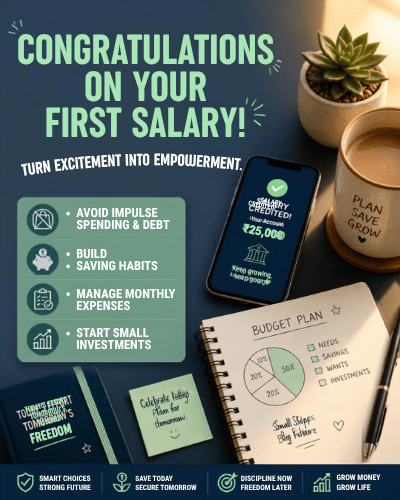
For years, young professionals live as students, depending on their parents for pocket money. Then, on one fine day, first salary comes into their Bank account. The excitement is hard to describe. Urges to buy clothes, upgradation of phone, Laptop becomes strong.
Common problems begins there, you feel richer in your first salary but in reality you are only financially independent.
Most of the persons have never managed rent, transport, groceries, utility bills and many of the household expenses due to the financial dependency. Ask for parents each time when are in short fall and never try to manage their pocket money.
Financial education is must required now a days in high schools, colleges and universities. Most dangerous trap for young peoples is that they can afford all and an immediate need to improve their life style like to replace old phone with new one, replace motorcycle / car. Buying expensive thing on installment is also one the Trap offered by different Banks and companies.
A rarely discussed point is that newly employed persons may feel pressure to prove that they are successful and repeatedly spending money that don't have because they are worried about what other people think.
Managing your money wisely starts with cash management technique. The process of tracking income, expenses, budgeting and saving systematically is very essential as oxygen is essential for life. Experts describe cash management systems as tools to handle cash flows efficiently. In a personal finance context, this means creating a budget, monitoring your spending and automating savings or payments so you always know where your money goes. Good cash management helps even low earners stay afloat, for example, 78% of Americans live paycheck to paycheck, highlighting why students and new employees especially benefit from these habits. By learning to manage cash early, young professionals can avoid debt and build a more secure financial future.
Why Manage Your Cash and Save for the Future
Effective cash management matters because inflation and unexpected costs can wear down your income. When prices rise, “your money ‘buys less’ over period of time”. In practice that means a fixed salary or savings account may not keep up with rising grocery or rent costs. To stay ahead, it’s crucial to save and invest even small amounts: financial advisors note that holding some assets (like stocks or mutual funds) can potentially outpace inflation. In other words, if you only keep cash, inflation will slowly shrink your purchasing power.
Moreover, life is unpredictable. Common expenses like a broken phone, medical bill or a travel cost for a family event can strike any month. New graduates often make the mistake of not budgeting for these emergencies. By building even a modest emergency fund (ideally covering 6–8 months of living costs) and saving a portion of each paycheck, you create a buffer that keeps small crises from ruining your finances. In short, good cash management means paying yourself first, set aside savings as soon as you get paid, so future “unplanned” expenses are already accounted for.
Setting Up a Budget and Tracking Every Rupee
A budget is your roadmap. It starts by listing all income and expenses each month. Use your pay slips to tally take home pay and note any extra earnings (side gigs, stipends etc.). Then list fixed costs (rent, tuition, bills) and variable costs (groceries, fuel, phone). Keep track of every purchase you made even small ones like snacks or rideshares for at least a month. South State Bank advises listing all income sources and expenses (even “Dunkin’ runs” and snacks) so you can truly see where money goes. This practice alone often reveals surprising spending habits (e.g. “I didn’t realize I spend dollars daily on coffee!”) and helps identify categories to lean as emergent requirement.
There are many budgeting methods to organize these numbers. A popular rule of thumb is the 50/30/20 split, which mean, give 50% of after tax income to needs like rent and food, 30% to essential wants and 20% to savings / debt repayment. You might also try the zero based budget, which assigns every rupee a purpose so nothing is left idle or unattended.
The “cash-envelope” approach is another method which means withdraw your budgeted spending money in cash and divide it into labeled envelopes (e.g. “Food”, “Transport”). When an envelope is empty, you should stop spending in that category and to audit why so much expend that envelope is empty now. In today’s digital era, applications like Mint, Pocket Guard or even a simple spreadsheet can help automate this.
Saving Strategies and Building Your Fund
Once you have a budget, make saving a nonnegotiable line item. Even on a tight salary, start small, say 5 to10% of each paycheck and increase it over time. Automate these savings transfers to ensure consistency. For example, set up your bank or payroll so that a fixed amount goes into a savings account on every payday. Johnson Financial advises using automatic transfers to “pay yourself first” and build an emergency fund without having to think about it.
Aim to grow an emergency fund covering at least 3 to 6 months of living costs. Keep this fund in a separate savings account with low fees (away from your main checking) so you won’t be tempted to spend it. Even if you can only save 500 dollars / Rs or 1000 dollar / Rs each month, it adds up: over two years, just 1000 Rs / dollar a month can total 24,000 dollar / Rs, which might cover several months of food bills in a pinch. As you get raises automatically channel a portion (even 1 to 2%) into savings before adjusting your lifestyle.
Savings accounts, while safe, usually offer low interest that often doesn’t outgrow inflation, so, after building an emergency cushion, consider a higher yield options. Like National banks may offer high yield savings accounts or government savings certificates. Investing a portion of savings can also fight inflation.
For instance, in Pakistan you can start mutual funds with as little as Rs.500–1000. Building a diverse mix of assets (like stock funds, bonds or even gold) can potentially grow your savings faster than keeping all cash.
Starting an emergency fund is key. Whenever possible, set aside a bit of each paycheck for savings and aim to reach that 3 to 6 month goal. Johnson Financial recommends making it a habit: even small, regular deposits into an emergency account can protect you from going into debt when surprises hit.
Investing Even Small Amounts
You don’t need a lot of money to invest. Modern brokerage platforms let beginners start with very little. As RBC Direct Investing points out, you can open an investment account with as little as $1 and set up recurring purchases of stocks or ETFs. (In Pakistan, similarly, low-cost index funds and digital gold accounts allow small Rs. purchases.) The key is consistency and compounding, even if you invest just Rs.500 per month, over years that can grow substantially. RBC’s example shows that saving Rs.50 a month at 2% interest yields about 24,600 over 30 years, but investing that Rs.50 at a 10% average return could reach over 113,000.
Investing exposes you to market ups and downs, so stay informed and start safe. Good entry level options include diversified mutual funds or index ETFs (to spread risk) and stocks of stable companies. Many mutual funds have low minimums and let professionals manage the portfolio. Treasury or government bonds are another low-risk choice, though their fixed returns may not beat inflation. Diversification is crucial, as Western & Southern notes, having assets like stocks or real estate in your portfolio helps keep pace with inflation over time. Even buying a fractional share of a company each month can give your money a chance to grow. If investing seems complex, start with education, read up, use simulators or seek advice but remember, doing nothing is riskier in the long run than a cautious start.
Common Mistakes to Avoid
New earners often make predictable errors. Not budgeting at all is one big pitfall without a plan, it’s easy to overspend and lose track of where money goes. Equally, be realistic in your budget, don’t promise yourself only Rs.100 on outings if you normally spend more. Living beyond your means (buying things on credit you can’t immediately afford) is another trap. This can spiral into high-interest debt (especially from credit cards), you can spend through credit card but you will not be able to pay it in once that’s means, you are in debt, then you approach Banks for installment and you will pay installment instead of saving. Instead, follow budgeting rules and pay off any credit card balance in full each month.
Other mistakes include neglecting an emergency fund, without one, even a minor car repair might force you to borrow or sell investments and giving up on budgeting after just a month or two. Remember: a budget is a tool, not a punishment. If one plan fails, adjust it rather than abandoning it. Finally, avoid impulse spending, before non-essential buys, consider a 24-hour “cooling off” period or ask yourself if the purchase aligns with your goals. Seeking discounts and deals (as Citi suggests) can also stretch a tight budget. Building these habits early – planning for emergencies, sticking to realistic budgets, and resisting quick splurges – will pay off in financial stability down the road.
Tools, Tips and Best Practices
- Use budgeting tools: Mobile applications (e.g. Mint, PocketGuard) or simple spreadsheets can automate tracking. Connect your expenses real time with this.
- Automate savings: Set up automatic transfers to savings or investment accounts each salary day. Treat saving like a recurring bill you must pay yourself.
- Separate accounts: Keep separate checking and savings (or investment) accounts. This prevents accidentally spending what you meant to save. Look for savings accounts with no or low minimums to avoid fees.
- Review and adjust monthly: Check your budget at least every month or when your income and expense changes. Adjust categories as needed, maybe you consistently underspend in one area and can reallocate to savings.
- Leverage employee benefits: If your job offers a retirement plan or provident fund, contribute if possible, it’s “free money” and grows over time. Even in Pakistan, schemes like the Employee Retirement Benefit or voluntary provident funds can help.
- Stay educated: Learn financial basics from books, websites or courses. As one guide notes, financial literacy is a lifelong skill, never hesitate to ask banks or advisors for help if confused.
FAQs
Q: How much of my income should I aim to save?
A common guideline is to save at least 20% of your income each month as per the 50/30/20 rule. However, if that feels too high on a low salary, start smaller even 5 to10% and build it gradually. The key is consistency. Some experts suggest first building a modest emergency fund as of 3 months’ expenses) then increasing contributions for long term goals.
Q: I have debt. Should I save or pay it off?
It’s a balance. Always make minimum debt payments but also try to save something if you can. If you have high interest debt (like credit cards), focus on paying that down first. Even then, keep a small emergency fund (Rs.5000 to 10000) so you don’t rely on new debt for sudden bills. Once high interest debt is under control, direct more money toward savings and investments.
Q: How do I track my expenses without an app?
You can simply use a notebook or spreadsheets. Record each spending at day’s end. Mark categories (food, transport, etc.) and total them. At month’s end, compare against your income. This manual method is effective for staying aware of cash flow. Over time, if you prefer automation, there are budgeting apps that link to Pakistani banks or allow CSV import.
Q: Is it really worth investing a small amount?
Yes, even modest investing can help you to beat inflation. For example, if you invest Rs.1000 per month and earn modest returns, compounding can turn that into a significant sum over years. The comparison from RBC is striking, saving Rs.50/month at 2% interest yields Rs.24K in 30 years but investing the same Rs.50/month at 10% could grow to Rs.113K. Small consistent investments in a diversified fund or index (with minimal fees) give your money a chance to grow more than it would sitting idle.
Q: How do I avoid overspending on my credit card?
It’s the most important thing to Treat credit cards carefully, only charge what you can pay in full at month’s end. Experts recommend paying your balance every month to avoid interest. Keep a low credit utilization (ideally under 30% of your limit). If you struggle, use cash or debit cards for daily purchases and reserve credit cards for emergencies or planned purchases you can immediately afford.
By following these cash management practices, realistic budgeting, disciplined saving and informed investing students and new professionals can control their finances, reduce stress and steadily build toward their financial goals.