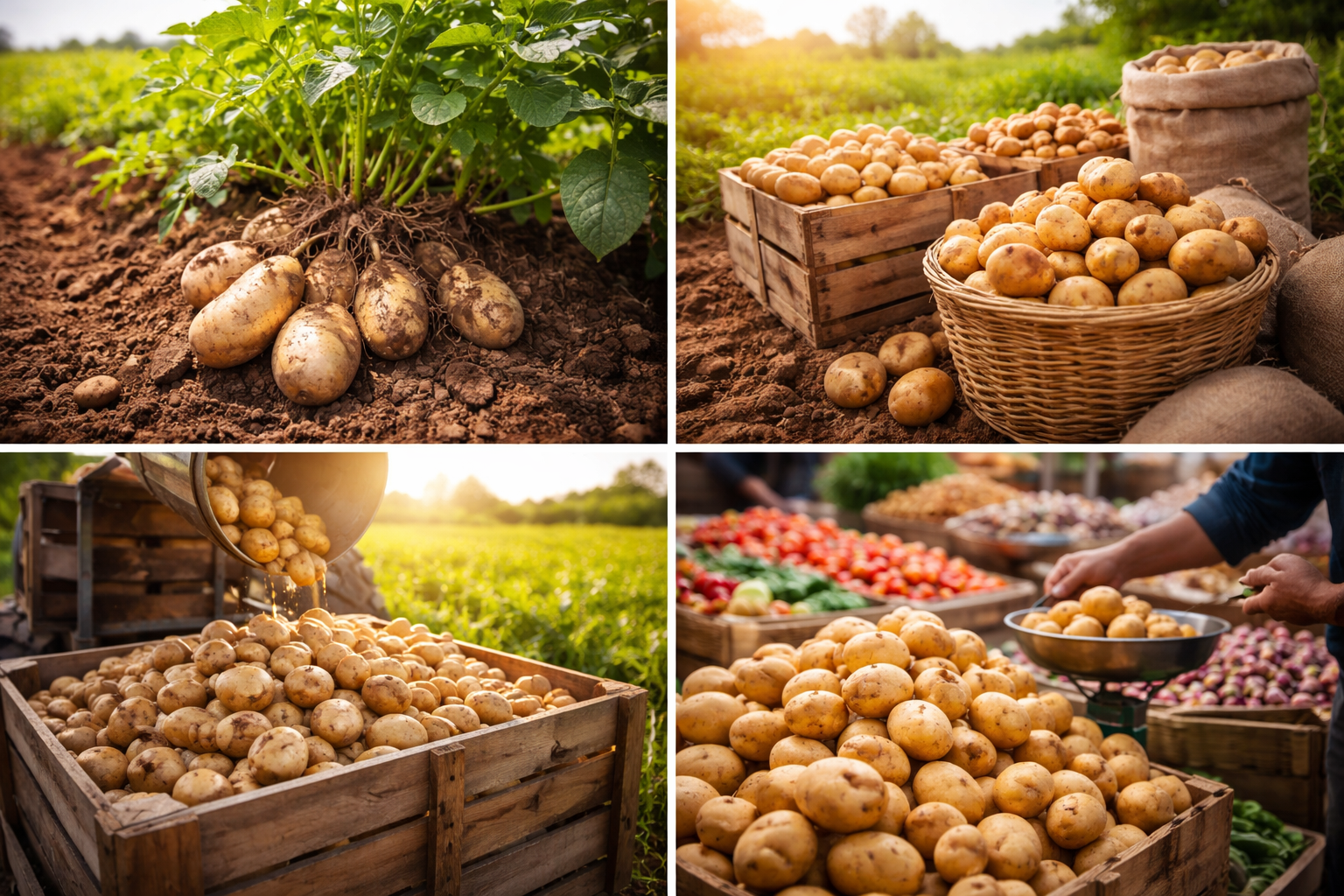
Why Pakistan’s state institutions remain silent is beyond the understanding of the general public. At a time when the country is facing severe economic hardship, potato exports could play a vital role in strengthening the national economy. The government’s closed eyes to an issue that is clearly visible to the public are increasing anxiety and unrest among the people.
The current market price of potatoes is not even covering farmers’ production costs. In contrast, potato prices in the international market are significantly higher than prevailing local prices.
If Pakistan were to export its surplus potato crop—which is approximately 7 million tons annually—it could prove highly beneficial for national trade and financial stability. At an average price of USD 450 per ton, the calculation would be:
7,000,000 × 450 = USD 3,150,000,000 (USD 3.15 billion).
An inflow of dollars on this scale would increase foreign exchange reserves, strengthen the value of the Pakistani rupee, and improve the country’s ability to repay external debt, potentially leading to a substantial reduction in liabilities.
Potatoes are one of the major crops cultivated in Pakistan. Many districts of Punjab hold a prominent position in terms of both yield and quality, accounting for nearly 95% of the country’s total potato production.
The leading potato-producing districts include Kasur, Okara, Pakpattan, Sahiwal, Toba Tek Singh, Khanewal, Sukkur, Khairpur, Bajaur, Chitral, Nowshera, and several others.
According to official statistics published by the Punjab government on its website, potato production during the year 2023–24 reached 8,236,260 tons, far exceeding domestic requirements. Estimates suggest that only 1,945,979 tons were needed to meet national consumption.
In the 2024–25 season, farmers sold a sack of potatoes in the market for up to PKR 4,600, whereas this year the same sack is selling for only PKR 1,200 to 1,300.
Previously, most of the surplus potato production was exported via Afghanistan, from where Pakistani potatoes were transported to Central Asian and Gulf countries. This resulted in substantial foreign exchange earnings for Pakistan, and farmers remained prosperous.
However, due to rising tensions with Afghanistan, potato exports through this route have come to a halt, leading to a sharp decline in prices. At current prices, farmers are unable to recover their production costs. Small-scale farmers have been directly affected; many have been forced to take loans to plant the next crop, while others are waiting for government assistance.
Due to the prevailing uncertainty, small farmers are hesitant to store their potato harvest. At present, Big landowners are storing the crop instead of selling it, but it is too early to predict the outcomes of this strategy.
International Markets for Pakistani Potatoes
Apart from Afghanistan, Pakistani potatoes are exported to the United Arab Emirates, Qatar, Kuwait, Sri Lanka, Malaysia, and Oman.
This raises a critical question: why has the closure of just the Afghan route caused such a drastic difference in prices? On this issue, the Government of Pakistan appears to be a silent spectator.
Countries That Import Large Quantities of Potatoes but Not from Pakistan are Belgium, the Netherlands, Spain, the United States, Germany, France, Italy, Japan, and Portugal.
The general public wants to know why, Pakistan is not entering into government-level trade agreements with them as these countries are big importers.
While a country like Afghanistan is actively strengthening its agricultural economy and export capacity, Pakistan—despite being naturally rich in agriculture—is declining due to ineffective government policies.